IMPERIA
Frau Brotbecks Gatte schaute gern „OLYMPIA“.
In seinem Eifer registrierte er sämtliche Kategorien: von Medaillenrängen über nationale Hymnen bis hin zum Wettlauf um Materialvorteile und der Proklamation sogenannter „Neutralitätsnormen“ des Internationalen Olympischen Komitees.
In seiner etwas naiven Sichtweise verband er, den Anspruch auf „Neutralität“ mit dem Gegenpol der “Polarität”. Polare Ansichten waren im Reglement des IOC nicht gestattet - weder in verbaler noch in nonverbaler Performance. Die hochgelobte Neutralität als Basis von Zensur versprach Spannung im kleinen Olymp* der “IOC-Gottheiten”.
Frau Brotbeck wurde zur Diskussion gebeten, ihr Gatte war verunsichert. Gemeinsam schwelgten sie in Erinnerungen an IMPERIA*, jene aus Künstlerhand geschaffene Kurtisane-Figur, die den Konstanzer Hafen zierte. In beispielhafter Eleganz entlarvt sie symbolische Machtinstanzen die sie auf ihren Händen präsentiert. Jene Figuren ließen sich mühelos durch “Embleme der Vereinigung” und das “Symbol der Justitia” ersetzen. Ein Spiel zwischen institutionellen Normen und dem Menschenrecht auf freie Meinungsäußerung entstand - ein Spiel, das selbst den Europäischen Sport-Gerichtshof in die „Neutralitätsfalle“ stolpern ließ. Neutralität als Normativ erwies sich alles andere als neutral: weder demokratisch, noch frei, noch ungebunden.
Herr Brotbeck staunte über diesen Diskurs. Poststrukturelle* Feinheiten wollte er sich nochmals fundierter von seinem philosophisch geschulten Freund bei Tee und Gebäck erläutern lassen.
Die Goldmedaille erhielt schließlich ein Skeleton-Künstler aus der Ukraine, der - als Sportler verkleidet - olympische Machtverhältnisse offenlegte und damit einen der wertvollsten Beiträge zur Demokratie und zu den inszenierten „neutralen“ Scheinwelten leistete.
Die wahrhaftigen Götter des Olymps jubelten!
* IMPERIA: Statue von Peter Lenk im Hafen von Konstanz. Wurde am 24.04.1993 aufgestellt und hat ein Gewicht von 18 Tonnen.
Olymp: Das höchste Gebirge Griechenlands. => Mythologisch : der Sitz der olympischen Götter (12 Götter des Olymps; Zeus, Poseidon, Hera, Demeter, Apollon, Artemis, Athene, Ares, Aphrodite, Hermes, Hephaistos und Hestia.
Poststrukturell: Lat. anterior = vorne, posterior = hinten, Struktur = Gebilde; Im engeren Sinne: “Was steckt hinter der Struktur”? Philosophische Strömung ab den 1960er Jahren. Hinterfragt feste Strukturen, Wahrheit, Identität und Sprache. Vertreter: Foucault, Derrida, Barthes
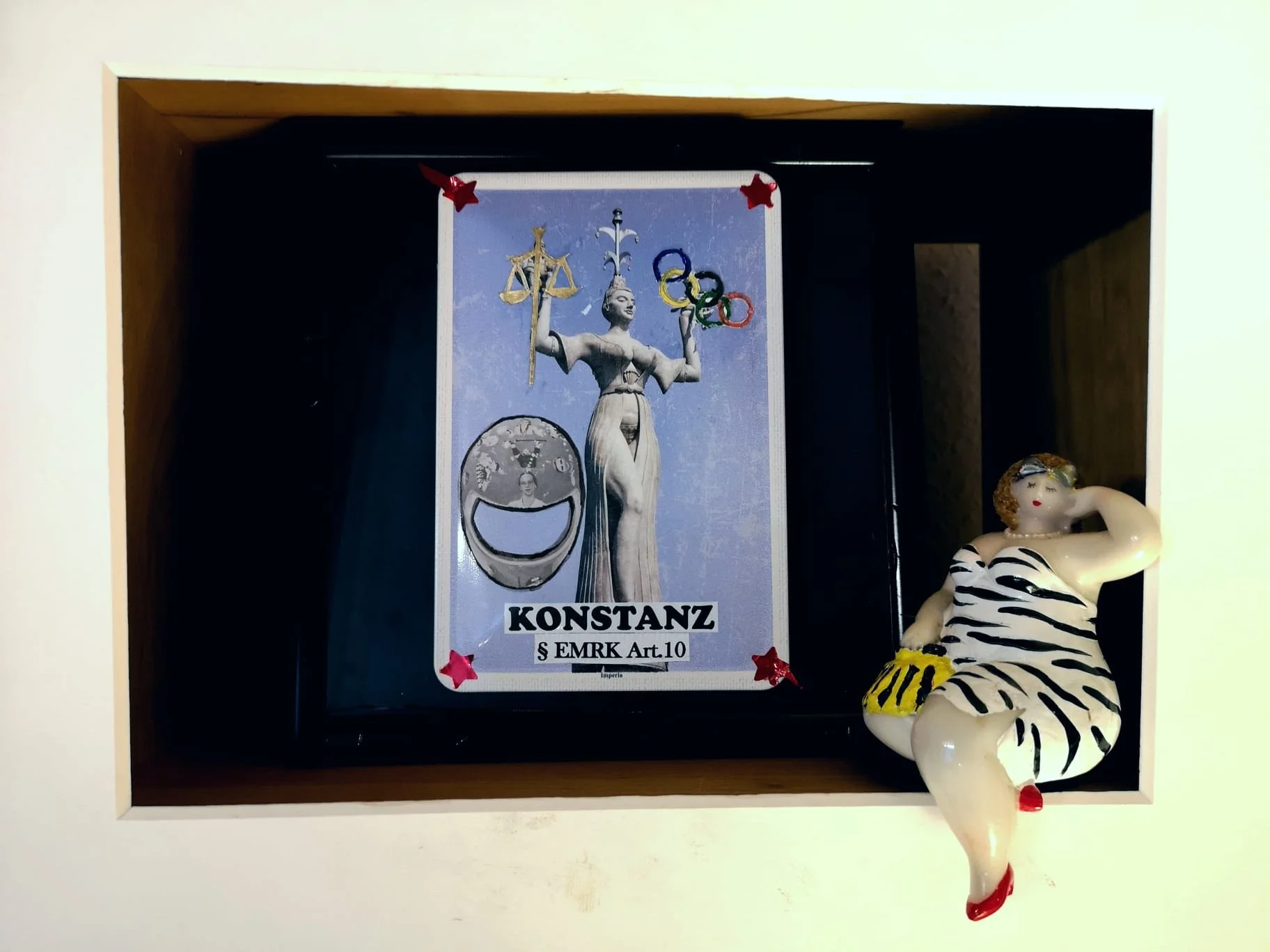
Collage olympiques
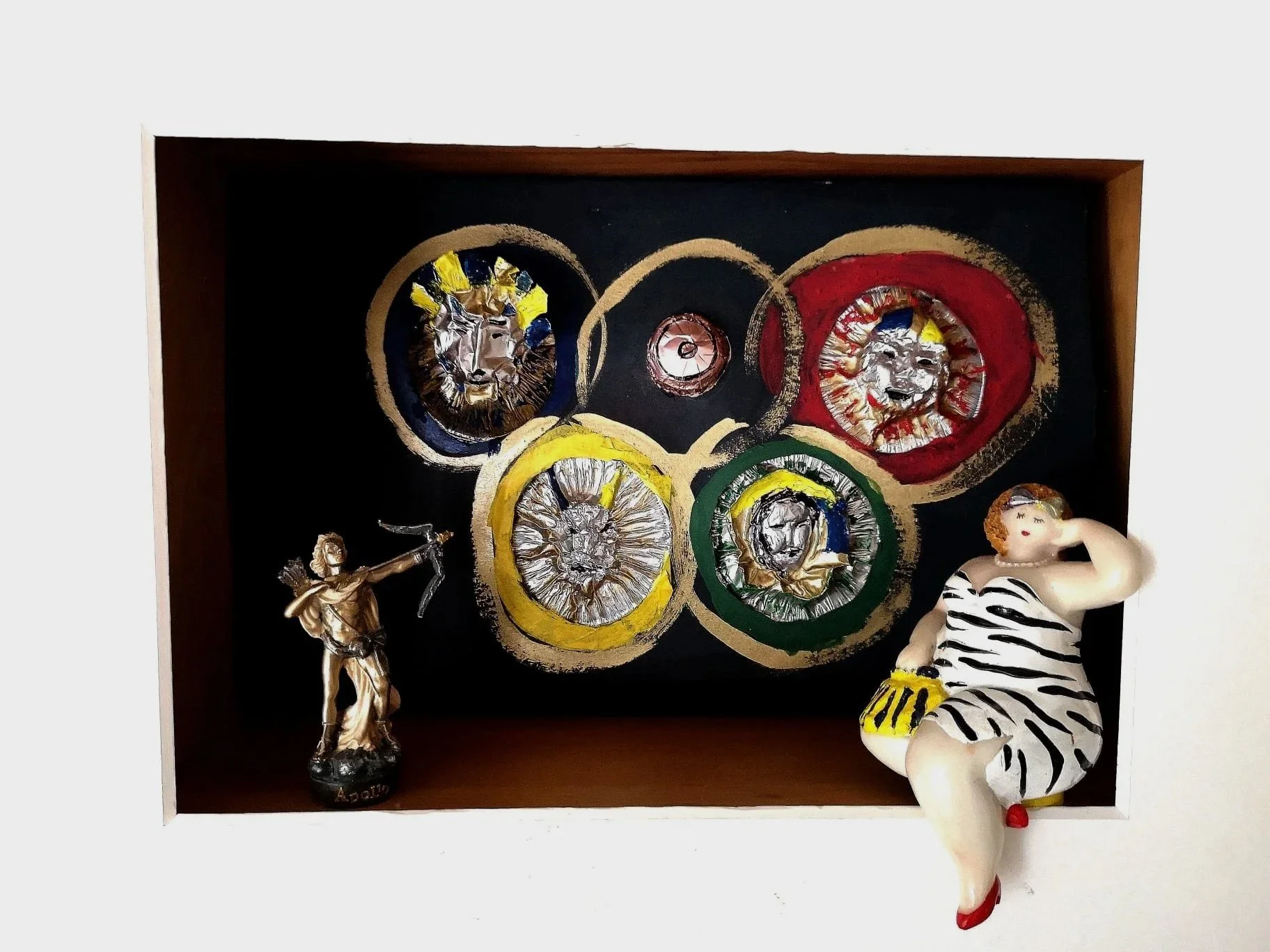
Collage of the Olympic sky.
Dedicated to the Paralympic teams
who stood in protest against the participation of athletes
from a state waging a war of aggression—
a state that simultaneously casts Western societies
as its enemy.
IMPERIA
Il marito della signora Brotbeck amava guardare “OLYMPIA”.
Nel suo fervore registrava tutte le categorie: dalle posizioni da medaglia agli inni nazionali, fino alla corsa ai vantaggi materiali e alla proclamazione delle cosiddette “norme di neutralità” del Comitato Olimpico Internazionale.
Nella sua visione un po’ ingenua, egli collegava la pretesa di “neutralità” al suo polo opposto, la “polarità”. Opinioni polari non erano ammesse dal regolamento del CIO, né in forma verbale né in performance non verbali. La neutralità tanto decantata, intesa come base della censura, prometteva tensione nel piccolo Olimpo delle “divinità del CIO”.
La signora Brotbeck fu invitata alla discussione; il marito era disorientato. Insieme si abbandonarono ai ricordi di IMPERIA, quella figura di cortigiana creata dalla mano di un artista che ornava il porto di Costanza. Con eleganza esemplare, essa smaschera le istanze simboliche del potere che presenta sulle proprie mani. Tali figure avrebbero potuto essere facilmente sostituite dagli “emblemi dell’unione” e dal “simbolo della Giustizia”. Nacque così un gioco tra le norme istituzionali e il diritto umano alla libertà di espressione — un gioco che fece inciampare persino la Corte europea dello sport nella “trappola della neutralità”. La neutralità come principio normativo si rivelò tutt’altro che neutrale: né democratica, né libera, né svincolata.
Il signor Brotbeck rimase stupito da questo discorso. Le sottigliezze post-strutturali* volle farsene spiegare con maggiore approfondimento dal suo amico filosoficamente preparato, davanti a tè e pasticcini.
La medaglia d’oro andò infine a un artista di skeleton proveniente dall’Ucraina che — travestito da atleta — mise a nudo i rapporti di potere olimpici, offrendo così uno dei contributi più preziosi alla democrazia e ai mondi fittizi “neutrali” messi in scena.
I veri dèi dell’Olimpo esultarono!
IMPERIA:
Statua di Peter Lenk nel porto di Costanza. È stata installata il 24 aprile 1993 e pesa 18 tonnellate.
Olimpo:
La catena montuosa più alta della Grecia.
Significato mitologico: la dimora degli dèi olimpici (i dodici dèi dell’Olimpo: Zeus, Poseidone, Era, Demetra, Apollo, Artemide, Atena, Ares, Afrodite, Ermes, Efesto e Estia).
Post-strutturalismo:
Dal latino anterior = davanti, posterior = dietro, struttura = costruzione.
In senso più ristretto: “Che cosa c’è dietro la struttura?”
Corrente filosofica sviluppatasi a partire dagli anni Sessanta. Mette in discussione strutture fisse, verità, identità e linguaggio.
Principali rappresentanti: Foucault, Derrida, Barthes.
IMPERIA
Mrs. Brotbeck’s husband enjoyed watching the “OLYMPIA” games.
In his zeal, he took note of every category: from medal rankings and national anthems to the race for material advantages and the proclamation of so-called “neutrality standards” by the International Olympic Committee.
In his somewhat naïve view, he linked the claim to “neutrality” with its opposite, “polarity.” Polar views were not permitted under IOC regulations—neither in verbal nor in nonverbal performance. The highly praised neutrality, serving as a basis for censorship, promised excitement within the small Olympus of the “IOC deities.”
Mrs. Brotbeck was invited to join the discussion; her husband felt unsettled. Together they indulged in memories of IMPERIA, the courtesan figure created by an artist that adorned the harbor of Konstanz. With exemplary elegance, she exposes symbolic power structures, which she presents in her hands. These figures could easily be replaced by “emblems of the union” and the “symbol of Justitia.” A play emerged between institutional norms and the human right to freedom of expression—a play that even caused the European Sports Court to stumble into the “neutrality trap.” Neutrality as a norm proved to be anything but neutral: neither democratic, nor free, nor unbound.
Mr. Brotbeck marveled at this discourse. He wished to have the post-structural* subtleties explained to him in more depth by his philosophically trained friend over tea and pastries.
In the end, the gold medal went to a skeleton artist from Ukraine who—disguised as an athlete—laid bare Olympic power relations and thus made one of the most valuable contributions to democracy and to the staged “neutral” worlds of illusion.
The true gods of Olympus rejoiced!
IMPERIA:
Statue by Peter Lenk in the harbor of Konstanz. It was installed on April 24, 1993, and weighs 18 tons.
Olymp:
The highest mountain range in Greece.
Mythological meaning: the seat of the Olympian gods (the Twelve Olympian Gods: Zeus, Poseidon, Hera, Demeter, Apollo, Artemis, Athena, Ares, Aphrodite, Hermes, Hephaestus, and Hestia).
Post-structuralism:
From Latin anterior = front, posterior = back, structure = form/construct.
In a narrower sense: “What lies behind the structure?”
A philosophical movement from the 1960s onward. It questions fixed structures, truth, identity, and language.
Key figures: Foucault, Derrida, Barthes.
IMPERIA
Le mari de Madame Brotbeck aimait regarder « OLYMPIA ».
Dans son ardeur, il enregistrait toutes les catégories : des classements de médailles aux hymnes nationaux, en passant par la course aux avantages matériels et la proclamation des soi-disant « normes de neutralité » du Comité international olympique.
Dans sa vision quelque peu naïve, il associait la revendication de « neutralité » à son pôle opposé, la « polarité ». Les positions polarisées n’étaient pas autorisées par le règlement du CIO – ni dans l’expression verbale ni dans la performance non verbale. La neutralité tant vantée, érigée en fondement de la censure, promettait une certaine tension dans le petit Olympe* des « divinités du CIO ».
Madame Brotbeck fut conviée à la discussion ; son époux était déstabilisé. Ensemble, ils se plongèrent dans leurs souvenirs d’IMPERIA*, cette figure de courtisane façonnée par la main d’un artiste, qui ornait le port de Constance. Avec une élégance exemplaire, elle dévoile les instances symboliques du pouvoir qu’elle présente sur ses mains. Ces figures auraient pu être aisément remplacées par des « emblèmes de l’union » et par le « symbole de la Justice ». Un jeu s’installa entre les normes institutionnelles et le droit humain à la liberté d’expression – un jeu qui fit même trébucher la Cour européenne du sport dans le « piège de la neutralité ». La neutralité, érigée en norme, se révéla tout sauf neutre : ni démocratique, ni libre, ni indépendante.
Monsieur Brotbeck s’émerveillait de ce discours. Les subtilités post-structuralistes* demandaient, selon lui, à être réexpliquées de manière plus approfondie par son ami philosophiquement formé, autour d’un thé et de quelques pâtisseries.
La médaille d’or revint finalement à un artiste de skeleton originaire d’Ukraine qui – déguisé en sportif – mit ouvertement en lumière les rapports de pouvoir olympiques et livra ainsi l’une des contributions les plus précieuses à la démocratie et aux mondes illusoires mis en scène comme « neutres ».
Les véritables dieux de l’Olympe exultèrent !
IMPERIA :
Statue de Peter Lenk dans le port de Constance. Elle a été installée le 24 avril 1993 et pèse 18 tonnes.
Olympe :
La chaîne de montagnes la plus élevée de Grèce.
Signification mythologique : le siège des dieux olympiens (les douze dieux de l’Olympe : Zeus, Poséidon, Héra, Déméter, Apollon, Artémis, Athéna, Arès, Aphrodite, Hermès, Héphaïstos et Hestia).
Post-structuralisme :
Du latin anterior = devant, posterior = derrière, structure = construction.
Au sens strict : « Qu’y a-t-il derrière la structure ? »
Courant philosophique apparu à partir des années 1960. Il remet en question les structures fixes, la vérité, l’identité et le langage.
Principaux représentants : Foucault, Derrida, Barthes.
